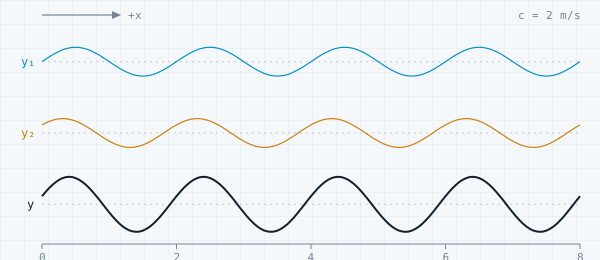
When two waves have equal amplitudes and a phase difference of zero, how many times larger is the resultant amplitude than a single wave?
What happens to the resultant displacement when two waves of equal amplitude have a phase difference of π?
If one of the two amplitudes is set to zero, what is left of the resultant?