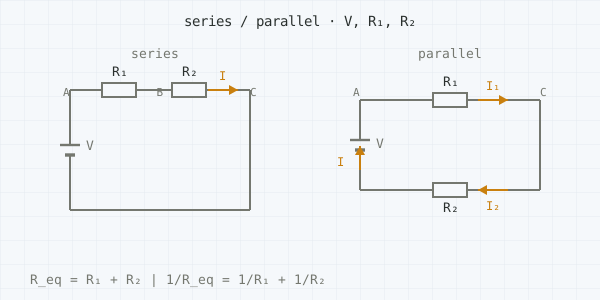
Why do the voltages across the two resistors of a series circuit add up to exactly the source voltage?
Why does the sum of the two branch currents of a parallel circuit equal the total current supplied by the source?
Why is the series equivalent resistance always larger than either resistor, while the parallel equivalent resistance is always smaller than either one?